Member login
The future of waste management
Few understand the operational complexities of waste management quite like David Meehan, Head of Operations at ERP UK. He has spent three decades in the waste sector involved with services across packaging, WEEE and batteries.
Q&A with ERP UK's Head of Operations, David Meehan
Few understand the operational complexities of waste management quite like David Meehan, Head of Operations at ERP UK. He has spent three decades in the waste sector involved with services across packaging, WEEE and batteries.
We sat down with David to discuss the evolution of recycling attitudes, the challenges facing takeback programmes and why that old laptop gathering dust in your office cupboard matters more than you might think.
The role behind recycling
David, let's start with the basics. What does your role as Head of Operations at ERP UK involve?
A great place to start! I manage the team within ERP that does everything we need to make our members and the schemes compliant. That's right across packaging, electricals and batteries.
For packaging, that means we need to acquire packaging recovery notes (PRNs) to meet our members' obligations. For waste electricals, we physically have to collect waste electricals from around 400 recycling centres run by our local authority partners. I have a team of regional account managers who look after those councils and manage the collections to make sure we're collecting enough waste electricals to offset the scheme obligation. For waste batteries we collect in bulk from recycling centres as well as over 25,000 other collection points - the tubes you see in retail outlets, community sites, schools, that type of thing.
So, if the public take waste electricals or batteries to their local recycling centre, we're potentially one of the companies collecting from there.
That sounds like quite a complex operation.
It is. We have two customers - an internal customer which is the scheme, but we also have local authorities who are our customers too. And we're also a procurement body because we're procuring and managing a supply chain. Our role is also about making sure we've got a robust supply chain, that we audit all channels properly, and do everything we should from the regulatory perspective of waste collection, within the rules of each of those producer responsibility regimes.
Three decades of change in waste management
You've been in the waste sector for 30 years. How have attitudes and processes evolved, particularly around packaging, batteries and electronics?
When I first started, recycling was still in its infancy. If you think about packaging across the board, there was a bit of cardboard recycling going on, but people weren't really recycling at home either.
The industry has certainly changed. Some of that has been delivered through things like producer responsibility coming in. Some of that's because of wider initiatives such as the landfill directive back in 1997, which started to drive landfill diversion and recycling targets for local authorities. So, there have been many different elements contributing to change.
And as consumers, how much have we changed?
Massively. We've gone from not recycling at all to becoming slightly aware of recycling to doing it at home as a norm. But I think there's still lots to do in that space, particularly in the business arena. In England now we have new legislation called ‘simpler recycling’[1] that's just come in, which puts responsibility for there to be separate bins in most business to help capture more packaging – just like we have got used to at home. In Wales, that's the workplace regulations.
But in reality, it's still confusing. I'm in the industry and I look at a bin and go 'which bin do I put it in?' Or there are locations that still don't provide that choice. I think awareness for us as consumers still needs to increase, for sure.
What about waste electricals specifically?
Before the regulations came in in 2007 households were already recycling large items because they were an inconvenience and had value as scrap metal, but the regulations have driven the need to collect other streams – like small electricals, lamps and televisions. The volumes have increased, but it's a different type of collection cycle. Packaging is pretty immediate - you buy something, you need to unpackage it, so you throw it away. Whereas an electronic product could last one year, five years, seven years, 20 years. And then do you throw it away? You might pop it in the drawer because you think it has value or it's a data-bearing item, so you're afraid to just dispose of it.
That whole cycle is still a challenge within the recycling space for waste electricals. You can't predict the flows in the same way. You do get an underlying trend and government base targets on five-year trends, but that whole space is more difficult.
And batteries?
We all know what we should do with batteries and producers who are registered understand their obligations. But it's so convenient to throw it in the bin because it's a small item. Do you take it and put it in the collection tube in the retail outlet? Maybe you've got kerbside recycling at home and your local authority's collecting batteries. We do support authorities with collections, and try to encourage them to put that into their kerbside collection service. But far from everybody does that. And when they do, as a consumer, do you know you can use it as well? There’s a lack of awareness.
The EPR Effect
You mentioned that attitudes have changed. Has Extended Producer Responsibility been a catalyst for that?
Absolutely. For packaging, the brand owners and obligated companies - the awareness has massively changed. EPR has been that trigger because all of a sudden, many didn't even know the old packaging regulations existed. But now it's like, wow, we've got directors and board members in most companies talking about this regulation because it has a financial cost. It's been talked about and is really visible. So, I think just that change in legislation has been a valuable trigger.
What about for WEEE and batteries?
Most of the producers, certainly the manufacturer-type ones, have always been aware of the regulations since they've come in and always done the right thing. The challenge is where there's smaller importers or smaller companies that may not realise there's a threshold or that they need to comply. Or you get a new startup that's not fully aware of the suite of regulations they have to comply with. Unregistered companies - what we call free riders - are always going to be there. They undermine the system. We need continual education and enforcement activity.
The Takeback Challenge
How dependent is the success of takeback on the capacity within the waste management sector to actually process what's collected?
For waste electricals, capacity is generally not an issue in the UK. There was a high-profile company that went into liquidation at the end of 2025, which squeezed capacity a little bit, particularly for fridges and what we call cooling units. But there's still capacity in the market and there's a new facility coming on at the end of 2026 in the southeast of England.
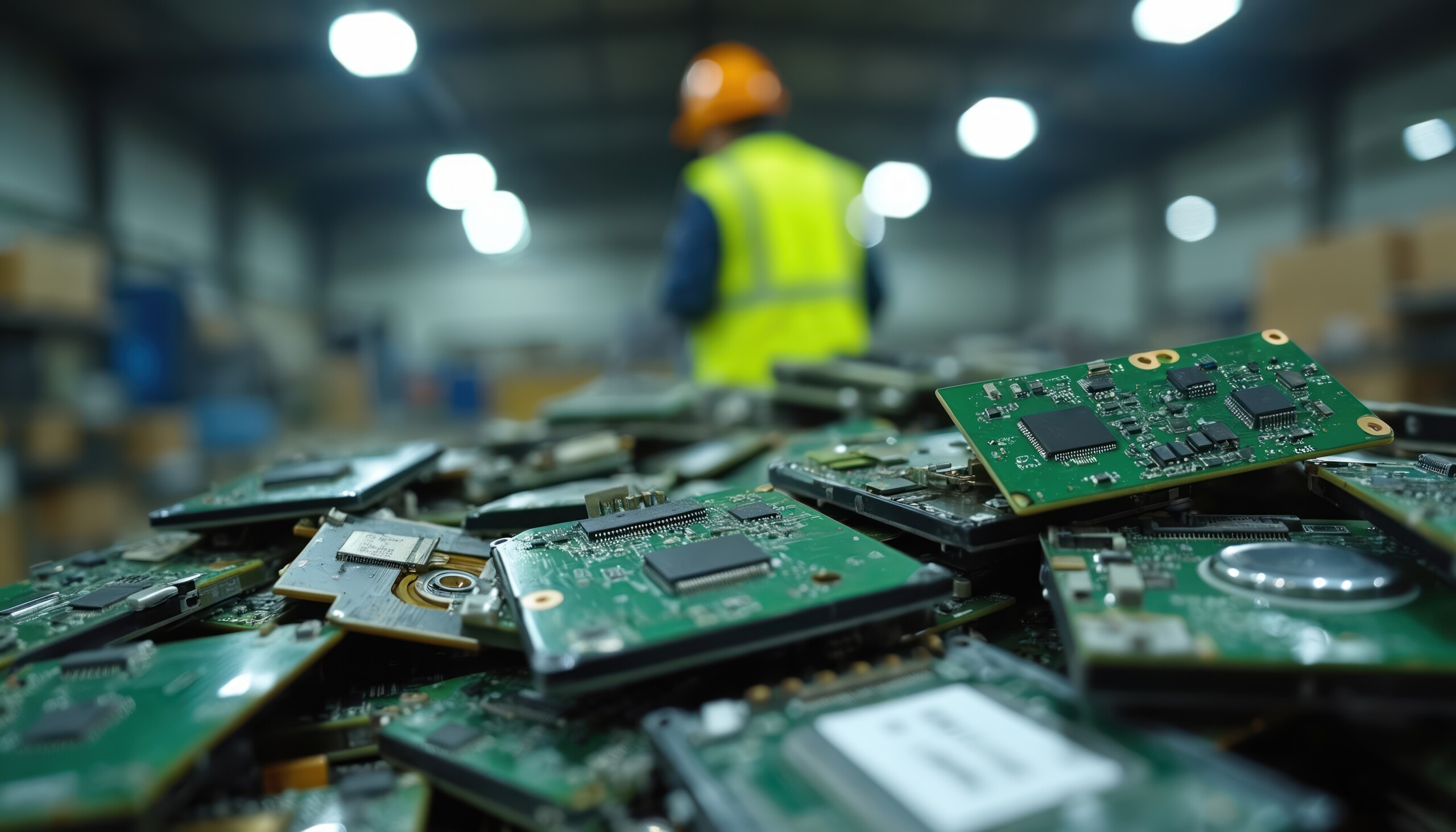
But I think where takeback particularly for waste electricals comes in is that lots of companies will have a cupboard, and it'll have that old laptop in there. It'll have the monitor that's been sat in there for 10 years since they went to flat panels. Big boxes of cables. That is effectively waste electricals that could and should be recycled by a company, and the staff never know what to do with it. They just know to go and put it in that room.
Public Awareness and Behaviour Change
We saw the 'Recycle Your Electricals' campaign last year. How effective are campaigns like that at genuinely moving the dial on people's behaviour?
I'm really supportive of Material Focus, [an independent not-for-profit organisation funded through the UK’s Extended Producer Responsibility regulations] which is behind the Recycle Your Electricals campaign. I honestly believe, domestically, behaviour has changed.
Behaviour is a constant thing you have to drive home, and it's how much money can you put into that space. Or does it need the wider media to give positive messages about recycling and what needs to be done, rather than just always targeting plastic being the bad thing? What about good old electronics and what we should be doing with them? The BBC have done a little bit of that and Material Focus have been on the sofa a couple of times, but we could do with a lot more airtime on the stream.
The Plastic Problem
It seems consumers are often confused about what can and can't be recycled, particularly with different types of plastics. From a processing perspective, what creates this confusion?
If you think fundamentally about packaging materials, glass is glass pretty much. Paper and cardboard - two slightly different grades but ultimately straightforward to recycle. Aluminium drinks cans are aluminium. Steel cans are steel cans. Even if there is a little bit of residual contamination on it, it'll burn out in a furnace anyway.
But then you get to plastic and you have this array of polymers. Whether it's a PET drinks bottle or PP food tray, PE food tray, LDPE shrink wrap type films and PVC melts at a different temperature. So, it's really more difficult to separate, and more difficult to manage.
What makes films and flexibles particularly challenging?
Rigid products are easier to sort because they're 3D, so they're easier to put over belts and through different separation processes. Whereas films and flexibles can be an array of polymers. They can be laminated into multi-layered material, which is really difficult to recycle. The initial separation is different because often it can be more manual, although there are some automated processes being put in at sorting sites now.
The whole waste sector finds that challenging. Consumer struggle too. They wonder, why can I put a plastic drinks bottle in the recycling bin, but not my plastic film? It is this massive array of polymers that causes the problem.
What’s going to change to make plastic recycling easier?
Under the UK government’s Simpler Recycling reforms for England, the mandatory, nationwide collection of plastic films and flexibles – thinks like crisp packets, and bread bags - from households and businesses is due to come into effect by 31 March 2027. This waste will have to be collected by local authorities. That's the backstop on that. The sector needs to gear up to manage that over the next 12 months really. That is going to be challenging.
The Circular Economy Vision
What is EPR fundamentally trying to achieve for the UK's circular economy?
EPR is trying to get more monomaterials that are easier to recycle, to make the downstream collection easier because there's fewer material types. When you target it at the materials recovery facility or the final re-processor, you can then extract that material cleanly and therefore recycle it. Together, we can improve capture rates, improve our recycling rates in the UK and get more material back into circulation.
That's the whole premise of why that part of the regulation exists - to make sure the UK meets its recycling targets. Because we have been stagnant pre-EPR, and that was obviously one of the key drivers, apart from it being born out of EU regulation. How do we follow the circular economy? How do we develop and increase our recycling? How do we get it back into the same packaging in a closed loop?
Future of waste management requires expert support
Whether you're navigating WEEE compliance, establishing battery takeback programmes or managing packaging obligations under the new EPR regulations, the operational complexities can be daunting. As David's insights reveal, successful waste management requires robust supply chains, regulatory expertise and a deep understanding of material flows.
ERP UK are recognised specialists in takeback services across WEEE, batteries and packaging
With hundreds of businesses trusting us to simplify their compliance obligations, we combine leading expertise with data-driven solutions to help organisations meet their environmental responsibilities while contributing to the UK's circular economy.
From council collections and retail takeback schemes, to comprehensive compliance reporting, our team manages the full spectrum of producer responsibility obligations. We work with major retailers and support local authorities across the UK. We provide collection services that keep valuable materials in circulation.
Ready to discuss your takeback requirements?
Our team of specialists can help you navigate the evolving regulatory landscape and establish compliant, efficient recycling programmes tailored to your business needs.
Contact ERP UK today:
- Contact us today here
- Email: info@erp-recycling.org
- Call: 0845 230 2340
Related services
WEEE Compliance: Our WEEE compliance scheme simplifies environmental compliance for companies making or importing electrical and electronic equipment. Our solution takes care of all your legal obligations from registration and reporting to collection and recycling.
Visit our WEEE Compliance webpage for further details
Visit our Takeback services webpage to find out how ERP UK can help your business with takeback solutions - click here.
About ERP UK
To learn more about ERP UK and our services please visit our About page
Contact us today:
Telephone: +44 (0)20 3142 6452
E-mail: uk@erp-recycling.org
Follow ERP UK on LinkedIn here


Share on